
Overview
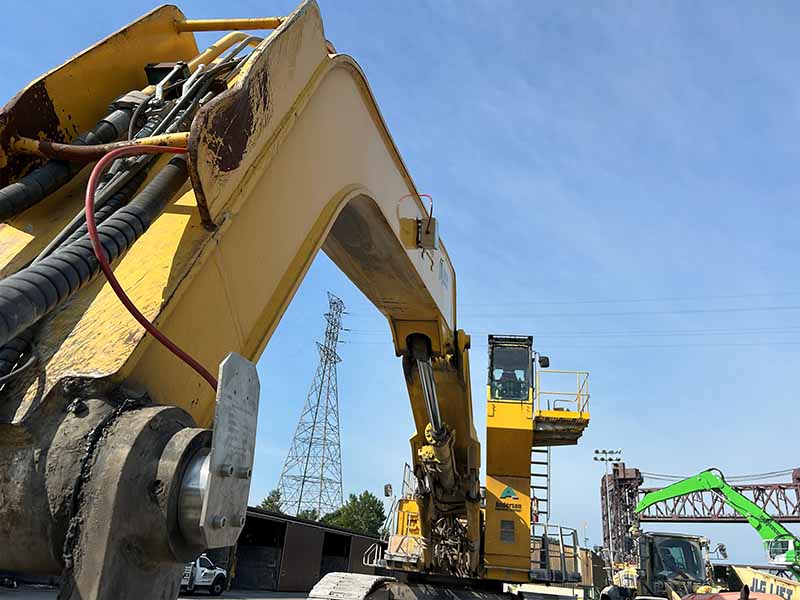
In 2025, a full-service supply chain solutions company contacted Rugged Controls in need of a reliable way to monitor load capacity on a fleet of specialized material handling machines, which were being used for salvage and bulk transportation operations. Unlike traditional cranes, these machines operate more like large backhoes equipped with a boom, jib, and custom end tools for handling scrap and other materials.
Because the equipment operates near or over water, it falls under OSHA 1917 and OSHA 1919 requirements for real-time capacity monitoring and equipment certification, which are more complex requirements than those for basic load measurements. The customer partnered with Rugged Controls to design and integrate a retrofit monitoring system capable of tracking safe lifting limits dynamically in the field.
The Challenge
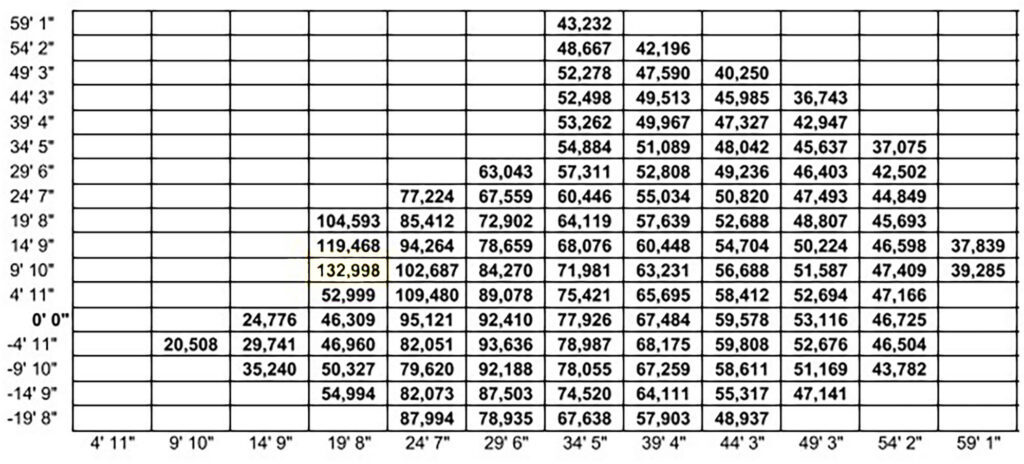
Material handling machines typically rely on 2D load charts to define safe lifting capacities at specific points in space, which are based on boom radius and height. However, these charts can sometimes include sparse or unevenly spaced data, leaving operators with an incomplete picture of actual lifting limits given numerous and varying potential configurations.
At ports and marine facilities, where space is tight and loads can sometimes be unpredictable, even small errors in load estimation can lead to tipping risks or questions of regulatory noncompliance.
They needed a way to:
- Accurately determine the position and angle of each boom segment in real time.
- Measure the live load being lifted.
- Compare that data against a complex 2D capacity map to ensure OSHA compliance and operator safety.
EXAMPLE of basic 2D load chart:
The Solution
Rugged Controls’ engineers developed a custom monitoring system built around the RPC-80x Programmable Controller, paired with angle sensors and a retrofit load pin installed at the end of the jib boom where it connects to the tool. This configuration enables the system to continuously determine the exact position of the tool in space and calculate both the actual weight and allowable capacity for that position.
The machine’s geometry is entered into the RPC-80x, and a two-dimensional load chart is digitized and loaded into the controller. Because the supplied charts often include only sparse lifting data points, our team applied a mathematical method that calculates the precise safe load capacity at any given boom position.
EXAMPLE of precise safe load calculation from Rugged Controls:
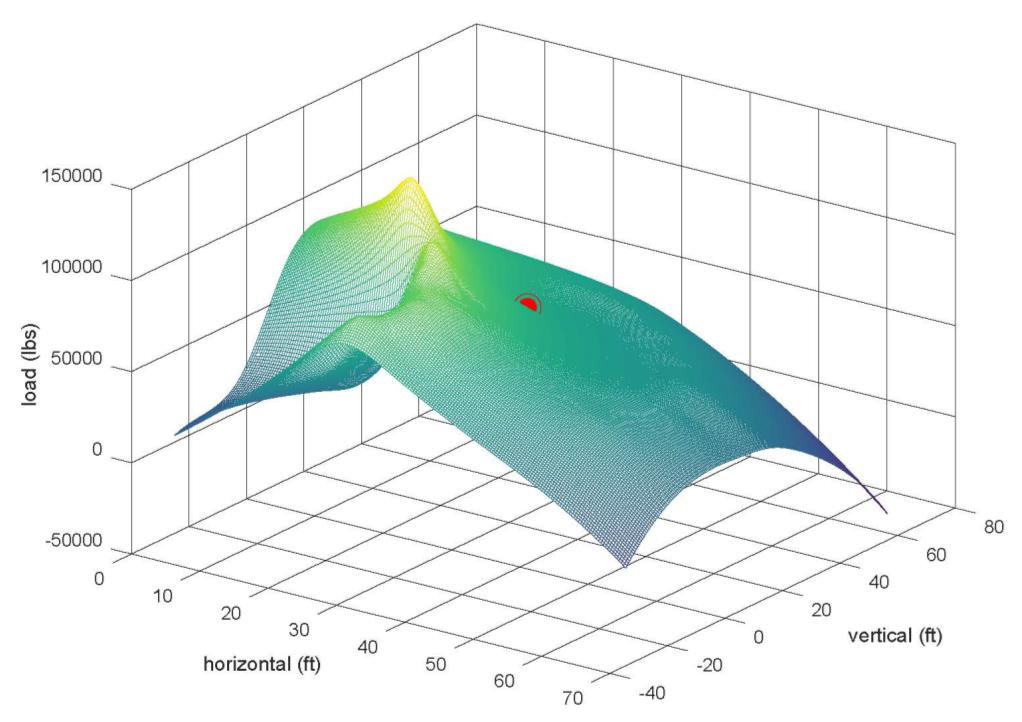
This approach delivers a far more accurate model of lifting capacity across the machine’s full operating envelope. The RPC-80x continuously compares real-time load and position data to the interpolated chart, displaying:
- Current load
- Maximum allowed capacity
- Percentage of rated capacity being used
If the operator approaches the configured capacity limit, the controller can be programmed to trigger alarms or restrict motion automatically. This real-time feedback satisfies OSHA’s requirements for dynamic capacity monitoring and improves operational confidence and safety.
Implementation Notes
This project was conducted remotely, with Rugged Controls providing calibration and configuration from our facility. The system’s simple wiring layout—a single connection to each angle sensor and one to the load cell—made field installation straightforward.
While calibration was completed in-house, correct sensor alignment was critical; each sensor needed to be mounted along the machine’s pivot line for accurate angular readings. For that reason, we typically recommend on-site engineering support or live remote supervision to ensure correct installation and optional in-field calibration post-deployment.
Results and Takeaways
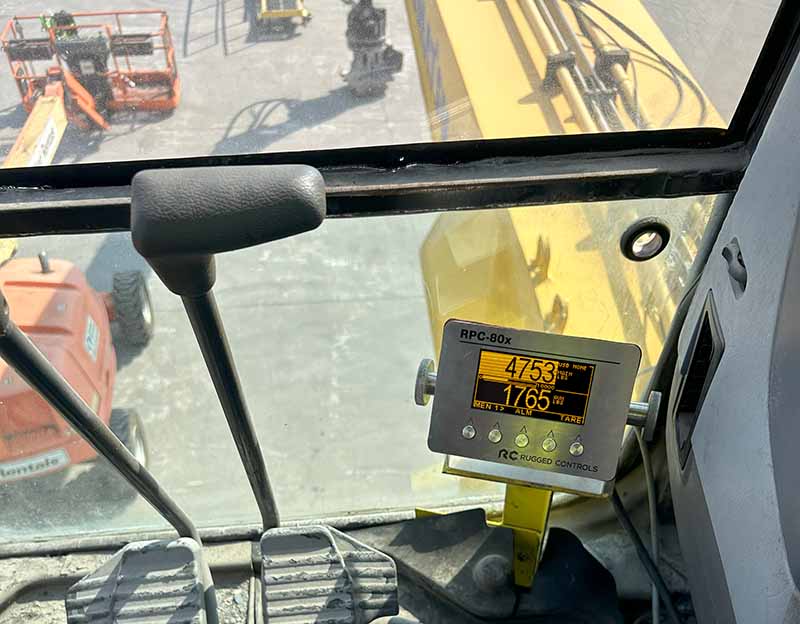
Our partner’s new system now provides operators with real-time insight into safe lifting limits at a much higher degree of precision, helping them meet OSHA compliance requirements while reducing the risk of equipment overload or instability.
Beyond this project, Rugged Controls’ capacity monitoring approach is adaptable to a wide range of mobile lifting and material handling machinery, particularly where traditional load charts or OEM systems fall short. Further, by measuring load at the tool directly, and knowing the tool’s exact location in space, this system from Rugged Controls provides an accurate and reliable solution that sets itself apart from systems dependent on hydraulic pressure readings alone (which indirectly measure load but are unable to determine exact location in space).
Our engineering team continues to refine these solutions for construction, maritime, and industrial applications, where safety, reliability, and data integrity are non-negotiable.
Conclusion
By integrating Rugged Controls’ RPC-80x Programmable Controller with custom load sensing and geometric modeling, our partner is now operating with a smarter and fully compliant lifting system.
If your operation faces similar compliance or safety challenges, our engineers can help develop a tailored control and monitoring solution for your environment.
